APPETITE & METABOLIC HEALTH
Tirzepatide
Human clinical studies
Tirzepatide is a peptide that activates two hormone receptors: GIP and GLP-1. These signals help coordinate appetite and the body’s response to food.
What it was developed or studied for
Developed to improve blood-sugar control in type 2 diabetes and studied extensively for weight management.
How it works
Its dual-receptor action influences appetite and supports glucose-dependent insulin release. In everyday terms, it works with signals that help regulate hunger and how the body handles blood sugar.
Positive findings & research focus
- Participants in an obesity trial achieved substantial weight reduction over 72 weeks alongside lifestyle support.
- Human studies have measured reduced appetite, food intake and fat mass.
- Research in type 2 diabetes has demonstrated improved blood-sugar control.
In SURMOUNT-1, average weight reductions ranged from 15.0% to 20.9% across study groups after 72 weeks. These figures describe that trial’s preparations, protocol and participants.
Explore the research
Obesity trialAppetite and body-composition studyType 2 diabetes trial
THREE METABOLIC PATHWAYS
Retatrutide
Human clinical studies
Retatrutide is a peptide designed to activate GIP, GLP-1 and glucagon receptors. Its three-receptor approach is being studied for obesity and metabolic health.
What it was developed or studied for
Developed to investigate whether combining three hormone pathways can produce meaningful changes in body weight and metabolic measures.
How it works
GIP and GLP-1 pathways participate in appetite and glucose regulation. The glucagon pathway adds another layer of metabolic signaling, which researchers are evaluating as part of the combined approach.
Positive findings & research focus
- A phase 2 obesity study reported substantial average weight reduction over 48 weeks.
- The same study recorded improvements in several blood-sugar, blood-pressure and lipid measurements.
- Its three-pathway design is a focus of ongoing weight-management research.
In the 2023 phase 2 trial, the highest study group averaged 24.2% weight reduction at 48 weeks, compared with 2.1% in the placebo group. Results belong to the study preparation and protocol.
Explore the research
Retatrutide phase 2 trial
VISCERAL FAT & HORMONE SIGNALING
Tesamorelin
Human clinical studies
Tesamorelin is a synthetic analogue of growth hormone-releasing hormone, or GHRH. It signals the pituitary gland to release the body’s own growth hormone.
What it was developed or studied for
Developed to address excess deep abdominal fat in people with HIV-associated abdominal fat accumulation. Researchers have also studied it in selected adults with abdominal obesity and reduced growth-hormone secretion.
How it works
Rather than supplying growth hormone directly, it stimulates the release pathway. Its research focus is visceral fat: the fat stored deeper in the abdomen around organs.
Positive findings & research focus
- Clinical studies in people with HIV-associated abdominal fat accumulation have measured reductions in visceral fat.
- A randomized study in that population also recorded a reduction in liver fat.
- Research in selected adults with abdominal obesity reported improvements in visceral fat and triglyceride measurements.
The strongest established human findings relate to the specific populations enrolled in these studies, particularly people with HIV-associated abdominal fat accumulation.
Explore the research
Visceral and liver fat trialAbdominal obesity study
CALM & EMOTIONAL REGULATION
Selank
Small human study
Selank is a synthetic peptide developed from the immune-signaling peptide tuftsin. Its research focus includes anxiety and the biological signals involved in emotional regulation.
What it was developed or studied for
Developed as an anti-anxiety research compound, with studies exploring anxiety symptoms and fatigue-related symptoms.
How it works
Researchers have investigated its interaction with neurochemical systems, including enkephalin signaling. These systems participate in how the nervous system processes stress and emotion.
Positive findings & research focus
- A small comparative study reported improvement in anxiety symptoms among participants receiving Selank.
- The study also reported improvements in fatigue-related symptoms and activating effects.
- Its research interest centers on anxiety relief and emotional regulation.
The cited 2008 study included 62 people with generalized anxiety disorder or neurasthenia; 30 received intranasal Selank. Its findings describe that study’s formulation and route.
Explore the research
Selank human study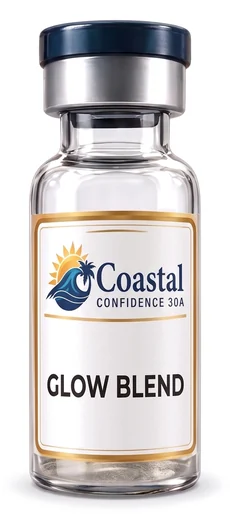
COPPER PEPTIDE & TISSUE-REPAIR RESEARCH
Glow Blend
Component-level laboratory and animal research
Glow is a blend name used here for GHK-Cu, BPC-157 and TB-500. Each component is associated with a different area of tissue-remodeling research.
What it was developed or studied for
The blend combines compounds researched for collagen biology, connective-tissue repair and cell movement during repair processes.
How it works
GHK-Cu is a copper-binding peptide studied for collagen and extracellular-matrix production. BPC-157 is researched in tendon and wound models. TB-500 is associated with thymosin-beta-4-related cell-movement research.
Positive findings & research focus
- GHK-Cu increased collagen production in cultured fibroblasts and matrix accumulation in an animal wound model.
- BPC-157 improved tendon-repair measurements in a rat Achilles-tendon study.
- Thymosin beta-4 and an actin-binding fragment promoted skin-wound repair in animal models.
These findings describe individual components and related research molecules in laboratory and animal models. Human outcomes for the combined injectable Glow formulation remain a research question.
Explore the research
GHK-Cu collagen studyBPC-157 tendon studyThymosin-related repair study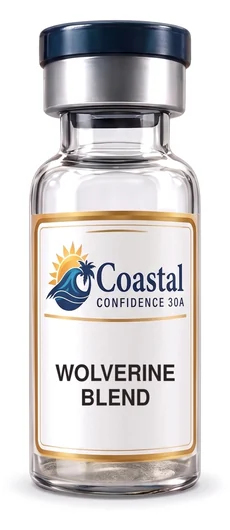
CONNECTIVE-TISSUE RESEARCH
Wolverine Blend
Component-level laboratory and animal research
Wolverine is a blend name commonly used for BPC-157 and TB-500. This section explains those commonly associated components; the product label establishes the exact formulation.
What it was developed or studied for
Combines peptides of interest in connective-tissue repair, wound biology and cell-movement research.
How it works
BPC-157 has been studied in models of tendon repair and tissue response to injury. TB-500 is a name associated with thymosin-beta-4-related peptides, whose research includes cell movement and repair signaling.
Positive findings & research focus
- In a rat Achilles-tendon model, BPC-157 improved tendon strength, functional measurements and repair structure.
- Cell-culture work has explored BPC-157’s effects on tendon-cell growth under experimental conditions.
- Animal research on thymosin beta-4 and its actin-binding fragment reported improved skin-wound repair.
The results above describe component research. Full-length thymosin beta-4, its fragments and commercial TB-500 formulations are distinct preparations; study findings apply to the molecule actually tested.
Explore the research
BPC-157 tendon-repair researchThymosin beta-4 and fragment researchPREPARATION & DILUTION
Bacteriostatic Water
Product function
Bacteriostatic water is a sterile water preparation containing a bacteriostatic preservative. It is a preparation supply rather than a peptide.
What it was developed or studied for
Designed as a diluent for compatible medications according to their preparation instructions.
How it works
The water provides a liquid vehicle, while the preservative helps inhibit bacterial growth within the preparation.
Positive findings & research focus
- Provides a sterile liquid vehicle for compatible preparations.
- Supports dissolving or diluting a compatible medication.
- Bacteriostatic formulations are supplied in containers designed for multiple withdrawals.
Its role is preparation and dilution; the active compound supplies the treatment effect.
Explore the research
Bacteriostatic water product information